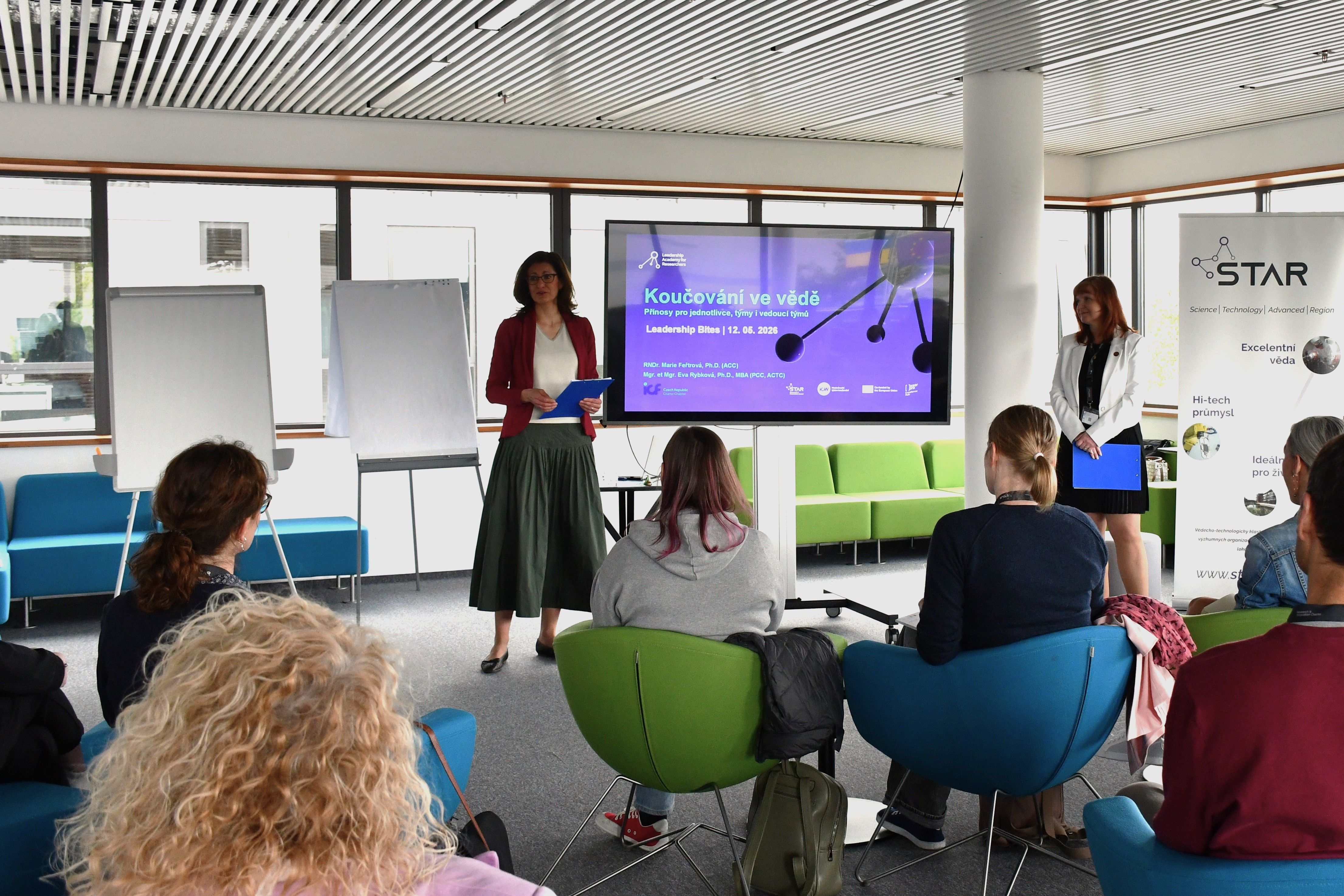
Why has coaching not yet found its place in the Czech research community, and why is it still relatively rarely used?
I think most people primarily associate coaching with business, corporate environments and sports. At the same time, I sense a certain degree of scepticism towards coaching in academia, partly stemming from the fact that it is often confused with other forms of professional development. Most commonly, coaching is mistaken for mentoring or consulting. However, these approaches address different needs, and it is useful to combine them.
So, what is the difference?
Mentoring is essentially about sharing experience, with the mentor drawing on their own academic background. They share with a colleague at an earlier career stage what has worked for them, what pitfalls to watch out for, introduce them to useful contacts and pass on good practices for dealing with specific situations. Consulting, on the other hand, involves providing information, recommendations and advice.
A coach’s role is different. It is based on expertise in facilitating structured conversations, active listening and asking questions. A coach does not need to be an expert in the particular scientific discipline or in academia itself. What they do need are the skills to create a safe and stimulating space in which researchers can find their own solutions, discover different perspectives and identify possibilities they may never have considered before. Coaching does not involve giving advice, recommendations or ready-made solutions. A coach does not assign tasks but supports researchers in identifying their own next steps, based on new insights, and taking action to achieve their goals or bring about change.
In what specific situations can coaching be useful for researchers?
Typical examples include making decisions about ambitious projects, accepting a new position, or figuring out how to identify problems within a team and actively address them. Coaching can also be valuable at career crossroads and when trying to bring order to the extremely demanding working lives of researchers, ensuring that everyday responsibilities do not distract them from their long-term goals or cause them to neglect their personal and family lives. It can also make a significant contribution to communication, burnout prevention and well-being within research teams.
However, you can bring virtually any topic to a coaching session, at any stage of your career. As Atul Gawande, the internationally renowned Harvard surgeon and scientist and a strong advocate of coaching, once said: “No one is so good that they don’t need a coach.”
Is coaching primarily a tool for individuals who want to work on themselves?
It does not have to be limited to individuals. In addition to one-to-one coaching, team coaching is another valuable approach, involving the entire team in addressing the issues and challenges they face. There is also group coaching, where participants share a common topic – for example, setting work priorities – but each person explores their own answers with the support of a coach facilitating the process. At the end, participants can also share insights and inspire one another.
In academia, coaching can also become part of a leadership style that empowers leaders to shape the atmosphere within their teams and across their entire institutions. For example, leaders can apply coaching principles when giving feedback, holding team meetings, supporting the career development of early-career researchers or addressing problems affecting their teams. In this way, they can create an open environment where everyone has a voice and help team members take greater responsibility for their own work and decisions.
And does a coaching-based leadership style actually work in science?
Absolutely. We also have international data to support this. For example, a study by the Wellcome Trust, involving more than 4,000 researchers and focusing on research culture, revealed a striking contradiction: while 84% of respondents said they were proud to work in research, only 29% felt confident about their long-term future in science, and 78% reported that extreme competitiveness created an unfriendly, even toxic, working environment.
The impact of leadership styles on workplace climate is also confirmed by an empirical study conducted by Susanne Braun and colleagues (2016), involving 440 academics. The findings showed that a coaching-oriented (transformational) leadership style among department heads was a statistically significant predictor of higher job satisfaction among team members, their willingness to go beyond their basic duties, and the overall organisational effectiveness of their departments.
We have already mentioned that coaching still has a relatively limited presence in the Czech research environment. What is the situation abroad?
At leading international research institutions, coaching and leadership based on coaching principles are well-established tools for developing people. The aim is to provide researchers with individual development support while equipping scientific leaders with coaching and management skills they can apply when leading their teams. This, in turn, has a direct impact on team dynamics, the quality of R&D outcomes and international competitiveness.
The underlying assumption is that scientific excellence and the ability to lead people are two distinct competencies, both of which can be systematically developed. In the Czech Republic, our focus has so far been primarily on developing scientific excellence.
Which international institutions could serve as an inspiration?
An especially inspiring example is ETH Zurich, one of Switzerland’s leading technical universities. It provides individual and group coaching for both academic and administrative staff and fosters a coaching mindset across the entire institution. Among the long-term outcomes of this culture are a willingness to translate research findings into practice and a high level of innovation. To put this into perspective, ETH Zurich generates an average of 30 new spin-off companies each year, while the entire Czech Republic produces fewer than 10 annually.
There are many other examples of good practice. The University of Oxford, for instance, provides researchers with individual coaching through its internal Oxford Coaching Network and also offers courses focused on applying coaching skills in team management. The Max Planck Society has incorporated coaching directly into its development programme for research group leaders as part of its Planck Academy. Similar initiatives can be found at the University of Cambridge (Postdoc Academy), Stanford University (Faculty Leadership Programme) and the University of British Columbia, which has a permanent team of in-house coaches.
Why do you believe coaching belongs in Czech science, and how can it help?
Coaching offers something that people working in today’s overstretched academic environment have surprisingly little of: time and a safe space to reflect on their own role, sharpen their strategic thinking, rethink their everyday working practices and clarify how they want to lead both others and themselves.
The purpose of bringing science and professional coaching together is not to replace scientific expertise with management training. Rather, it is to support the development of effective leadership and self-leadership competencies and help researchers achieve outstanding scientific results while maintaining a sense of purpose and enjoyment in their academic and research work.
Of course, professional coaching alone will not solve the systemic problems facing Czech academia. However, it can be a highly effective tool for helping move our research environment forward.
What would you recommend to those who are hesitant or sceptical about the potential of combining coaching and science?
Quite simply, give it a try. And if you are concerned that a coach might not understand the academic environment, you can look for someone who specialises in this sector and is also a professionally trained coach. It is similar to trying to explain to someone how wonderful swimming or cycling is and how positively it can affect their body and mood. Until they actually try it and experience it for themselves, it remains just words, and it can be difficult to imagine what they really mean.
In my experience, when a researcher comes to a coaching session for the first time, they are invariably amazed by how the process actually works and how much even a single session can bring them.
Marie Feřtrová is a certified coach, researcher, regional development expert and evaluator. She specialises in coaching and mentoring, with a focus on the academic environment (PhD students, postdoctoral researchers and research team leaders) as well as change-makers and innovators.